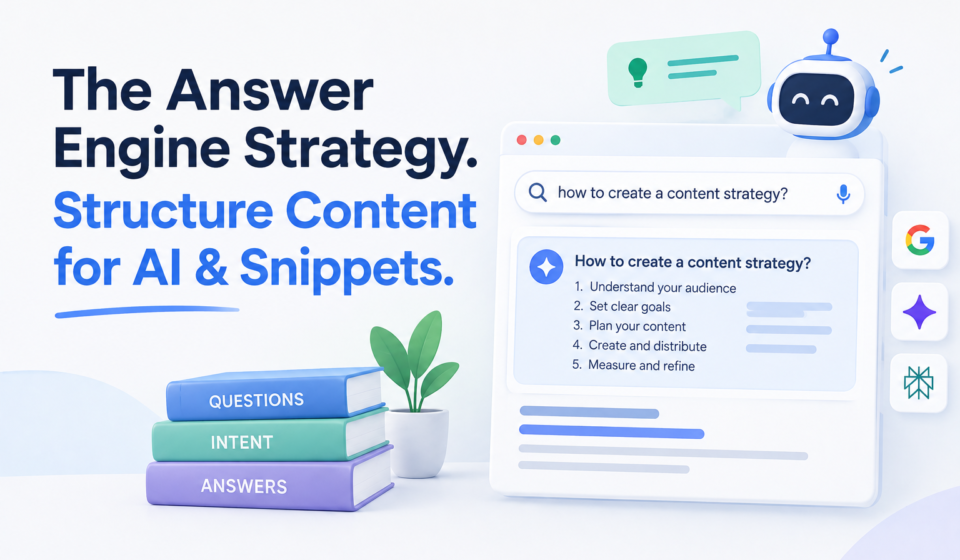
The Answer Engine Strategy: How to Structure Articles for AI and Featured Snippets
Search is no longer just about ranking a page in the top 10. Instead of scanning several blue links, users can now get direct answers through featured snippets and AI-powered search experiences. For publishers and businesses, that creates a different content challenge: it’s not enough to have the right answer — you need to make that answer easy to identify, understand, and extract.
That’s the idea behind an answer engine strategy. It combines traditional SEO with clearer content structure, question-based headings, concise answers, and useful supporting context. Done well, it helps your article serve readers first while giving search engines and AI systems a much clearer path through the information.
What Is an Answer Engine Strategy?
It’s about organising content around the questions people actually want answered — not just targeting a keyword in isolation.
Someone searching for “best running shoes” probably also wants to know which ones suit beginners, what features matter, what they should cost, and whether cushioning is important. A useful article addresses those connected questions without turning each variation into a separate, repetitive section.
The goal isn’t to write for AI. It’s to make information clear enough that readers, search engines, and AI systems can all follow it easily.
How Should You Structure Content for Better Understanding?
Start with the information architecture before worrying about featured snippets. Make sure the page has a clear topic and moves through it logically.
Give the Article One Clear Focus
Keep content centred on one primary search intent. Related questions can expand the topic, but they should support the main purpose — not pull the page in different directions.
Build a Logical Heading Hierarchy
H1 for the main topic, H2s for major sections, H3s for supporting points. A heading like “What Should You Look for When Choosing Running Shoes?” tells readers far more than “Other Things to Consider.”
Keep Related Information Together
Don’t separate an answer from the qualification or example needed to understand it. Keeping connected information in the same section creates a smoother reading experience and cuts unnecessary repetition.
How Can You Structure Content for Featured Snippets?
The right format depends on the type of question you’re answering.
Use Short Definitions for Simple Questions
For “what is” searches, put a concise definition directly under the relevant heading, then expand on it.
What is technical SEO?
Technical SEO is the process of improving a website’s technical foundation so search engines can crawl, understand, and index its pages effectively.
The explanation can then go deeper from there.
Use Numbered Lists for Processes
When readers need to complete tasks in a particular order, numbered steps work better than paragraphs.
- Crawl the existing website
- Identify important URLs
- Map old URLs to new ones
- Test redirects
- Update internal links
- Monitor indexing
Use Bullets for Groups of Items
Bullets suit information that doesn’t have a required sequence — a laptop guide listing processor, memory, storage, display, and battery life, for example.
Use Tables for Comparisons
When readers need to compare options, a table communicates differences faster than several paragraphs ever will.
| Option | Best For | Main Advantage | Limitation |
| Option A | Beginners | Easy to use | Fewer features |
| Option B | Small teams | Flexible | Learning curve |
| Option C | Large teams | More control | Higher cost |
Format should serve the information — not get added for SEO’s sake.
What Makes an Article Useful for AI-Powered Search?
AI-powered search needs context to interpret individual statements correctly. A few practices matter more than others here.
Establish Context
Don’t present statistics, recommendations, or claims without explaining what they refer to. A number without context can easily become misleading when it gets pulled away from the surrounding paragraph.
Explain Important Terms
Define technical terms, acronyms, or anything with multiple meanings when they first appear. It removes ambiguity and makes the article easier to follow for everyone.
Support Important Claims
Use appropriate evidence for claims that depend on research, data, regulations, or expert knowledge. Government information, academic research, industry data, and first-party evidence all work depending on the subject.
Add Original Value
Rewriting information already available across dozens of pages doesn’t give readers much reason to choose yours. Original analysis, practical examples, expert input, unique data, or useful comparisons change that.
Which On-Page Elements Matter?
| Element | Purpose |
| H1 | Defines the main subject |
| H2s/H3s | Organise major topics and supporting points |
| Lists | Present steps or grouped information |
| Tables | Compare options |
| Internal links | Connect relevant resources |
| Sources | Support factual claims |
| Structured data | Communicate eligible information in machine-readable form |
Use these to improve usability — not as isolated ranking tactics.
What Content Mistakes Should You Avoid?
Even well-researched content becomes difficult to use when the information is poorly presented.
Watch for:
- Burying the answer — making readers search through paragraphs to find the main point
- Vague headings — labels that don’t explain what the section actually covers
- Over-formatting — turning every paragraph into bullets or every heading into a question
- Keyword stuffing — repeating phrases unnaturally
- Empty FAQs — questions that simply repeat information already covered
- Unsupported claims — statistics or recommendations without appropriate evidence
- Lack of original value — repackaging existing information without adding useful insight
The objective isn’t to make every element optimised. It’s to make the article easier to use.
How Do You Build an Answer-First Article?
A simple workflow keeps the process focused:
- Identify the search intent — what does the reader want to know, solve, compare, or accomplish?
- Map related questions — find the supporting questions that naturally belong to the topic
- Create the hierarchy — organise those questions into H2s, H3s, and supporting content
- Choose the right format — definitions, lists, tables, or paragraphs depending on the information
- Add evidence and original insight — support important claims and look for gaps competitors haven’t filled
- Edit for clarity — remove repetition, unnecessary background, and sections that don’t serve the reader
Can Answer Engine Optimisation Work With Traditional SEO?
Yes — it adds to it rather than replacing it.
Technical SEO still affects crawling and indexing. Keyword research still identifies search demand. Internal links still help users and search engines find related content. Answer-focused optimisation adds one more consideration: how clearly does the page communicate information once it’s been discovered?
Traditional SEO asks whether a page is relevant to a search. An answer engine strategy also asks whether the page provides a clear, useful response to that search. The two work best together.
What Should You Check Before Publishing?
Before publishing, run through these:
- Does the article satisfy the main search intent?
- Is the heading hierarchy logical?
- Are related ideas grouped together?
- Does each section use an appropriate format?
- Are important claims supported?
- Does the article offer original value?
- Have unnecessary repetitions been removed?
- Are internal links genuinely relevant?
- Can someone understand the article by scanning its headings?
If the content works without relying on keyword repetition or filler, it’s in a much stronger position.
Make Your Content Easier to Understand, Extract, and Trust
An effective answer engine strategy isn’t about turning every article into robotic, short-form answers. It’s about organising useful information so its meaning is clear.
Start with the reader’s question, build a logical structure around it, choose formats that suit the information, and support important claims with credible evidence. Most importantly, give readers something genuinely useful rather than simply rewriting what already exists.
Search may be changing, but the basic principle stays the same: clear, useful, trustworthy information has value wherever people find it.
FAQs
1. Can an article rank well without appearing in an AI-generated answer?
Yes — traditional rankings and inclusion in AI-generated responses are different outcomes. A page can perform well in conventional search without being selected as a source for a particular AI response.
2. Should every H2 be written as a question?
No. Use question-based headings when they reflect genuine search intent. For broader subjects, descriptive headings are often clearer and less repetitive.
3. Can featured-snippet optimisation make an article harder to read?
It can if the article is structured entirely around extraction. Lists, short answers, and tables should improve usability — not replace the explanations readers actually need.
4. How long should an answer be for a featured snippet?
No universal word count. Give enough information to answer accurately, then add relevant context. The complexity of the question should determine the depth.
5. How can you optimise for AI search without keyword stuffing?
Focus on the topic rather than repeating a phrase. Cover relevant concepts, answer related questions naturally, explain important terminology, and support factual claims where needed.