Content has become easier to produce. Information hasn’t become easier to consume.
The answer might be buried beneath a 200-word introduction. The important point might sit inside a dense paragraph. The page might cover everything—but still make the reader work to find the one thing they came for.
That’s a problem.
People scan before they commit. They jump between headings, look for specific answers, and decide within seconds whether a page is worth their attention.
Search engines and AI systems have their own job too: understand what your content says and which questions it can answer.
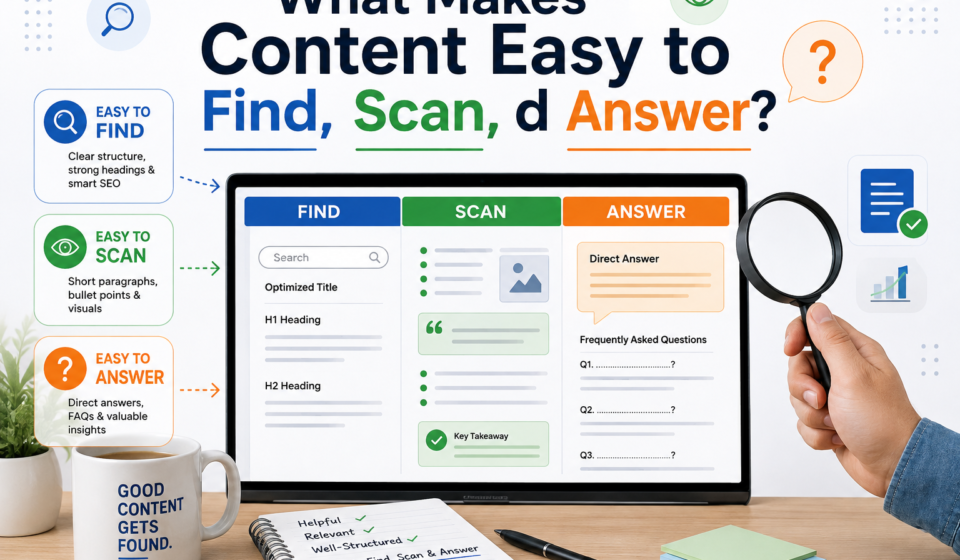
So good content has to do three things well:
Be easy to find.
Be easy to scan.
Be easy to answer.
What Does It Mean for Content to Be Easy to Find?
Being easy to find starts before someone lands on your page.
Your content needs to match what people are actually looking for.
That sounds obvious, but many content strategies still begin with a keyword list rather than a searcher’s problem.
Take “content marketing strategy.”
The person searching might want a definition. They might want a step-by-step process. They might be comparing agencies. They might be trying to figure out whether content marketing is even worth investing in.
The keyword is the same.
The intent isn’t.
That’s why discoverable content needs more than keyword placement. It needs a clear topic, relevant language, useful context, and a format that matches the searcher’s goal.
A page shouldn’t make search engines guess what it’s about.
And it shouldn’t make readers guess whether they’ve landed in the right place.
Why Do People Scan Content Before They Read It?
Because reading online is rarely linear.
People arrive with a question. They scan the headline, headings, opening lines, bullets, images, tables, and highlighted information.
Then they decide where to spend their attention.
That makes structure part of the content—not decoration added after the writing is finished.
Compare these two headings:
“Things to Consider Before Creating a Content Strategy”
and
“What Should a Content Strategy Include?”
The second immediately tells the reader what they’ll find.
Good headings create a map.
Useful formatting makes that map easier to follow.
Make content easier to scan with:
- Descriptive H2s and H3s
- Short paragraphs
- Bulleted lists
- Numbered steps
- Tables for comparisons
- Clear definitions
- Examples near complex explanations
- Important answers near the top
The goal isn’t to make every page look like a checklist.
It’s to reduce the effort required to understand it.
What Makes an Answer Actually Useful?
A quick answer isn’t automatically a good answer.
“Content marketing helps businesses grow through content” is technically an answer.
It’s also barely useful.
A stronger answer gives the reader enough information to understand what, why, how, or what next.
Useful answers tend to be:
Direct
Don’t make readers wait through a long introduction to reach the point.
Specific
Replace vague advice with something concrete enough to apply.
Contextual
Explain when the advice applies and when it might not.
Evidence-based
Use data, examples, research, or first-hand expertise where it strengthens the point.
Actionable
Give readers something they can actually do with the information.
The goal isn’t simply to answer a question. It’s to resolve the reason the question was asked.
Does Shorter Content Automatically Make Better Quick-Answer Content?
No.
This is where “quick answers” can be misunderstood.
A reader might want a quick answer to “What is AEO?”
That could take a paragraph.
But “How do I build an AEO strategy?” requires much more.
The answer may need examples, steps, tools, limitations, and context.
So don’t cut useful information simply to make a page shorter.
Instead, make the important information easy to access.
A 2,000-word article can be highly scannable.
A 500-word article can be painful to read.
Short isn’t the goal. Clarity is.
How Should You Structure a Page to Answer Questions Faster?
A useful structure is:
Question → Direct answer → Supporting detail → Example → Next relevant question
For example:
What is content marketing?
Content marketing is the process of creating useful, relevant content to attract, educate, and convert a specific audience.
Then expand.
Explain what it includes.
Give an example.
Show when it works.
Then move naturally into the next question:
What types of content does content marketing include?
Now the reader doesn’t have to search through the page to figure out what matters.
The structure does the work.
This approach also creates clearer signals for search engines and AI systems trying to understand the relationship between questions and answers on a page.
How Does Clear Structure Help With AI Search?
AI-powered search doesn’t just need to recognize keywords.
It needs to understand meaning, relationships, context, and relevance.
A clearly structured page makes those relationships easier to interpret.
Question-led headings can establish what a section is addressing.
A direct answer can establish the core point.
Supporting evidence can provide context.
Examples can clarify meaning.
Clear entity references can help connect the topic to people, companies, products, concepts, or organizations.
That’s where SEO, AEO, and GEO begin to overlap.
But there is an important distinction:
Don’t structure content for AI at the expense of people.
If your content is genuinely clear, useful, well-supported, and easy to navigate, you’re already creating stronger signals for both.
What Makes Content Hard to Find, Scan, or Answer?
Sometimes the problem isn’t what you included.
It’s what you made people work through to get there.
Common problems include:
- Keyword stuffing
- Generic headings
- Long introductions
- Buried answers
- Dense paragraphs
- Repetitive sections
- Unnecessary word count
- Unsupported claims
- FAQs added only for keywords
- Information without clear context
None of these automatically makes content bad.
But together, they create friction.
And online, friction costs attention.
Make the Answer Easier to Find
Good content doesn’t make people work to discover its value.
It tells them what the page is about.
It helps them navigate.
It answers the important question.
Then it gives them enough context to understand what that answer means.
That’s the difference between content that contains information and content that communicates information well.
The goal isn’t to say everything.
It’s to make the right information easier to find, easier to understand, and easier to use.
Questions People Ask
1. How do I make content easier to scan?
Use descriptive headings, short paragraphs, bullets, tables, clear answers, and enough spacing to separate ideas.
2. What makes content easy for search engines to understand?
Clear topic focus, relevant language, logical structure, descriptive headings, accurate information, and useful context all help search engines interpret content.
3. How long should an answer be for SEO?
There is no ideal universal length. Answer the question completely, then provide the context the reader needs without adding unnecessary information.
4. How do I write content for voice search?
Use natural language, answer specific questions clearly, and structure information so important answers are easy to identify.
5. What is answer-first content?
Answer-first content gives the reader a direct response to their question early, then provides supporting detail, examples, evidence, or context.
6. Does scannable content help SEO?
Scannability primarily improves usability, but clear structure can also help search systems understand the organization and meaning of your content.
7. Should I put the answer at the beginning of an article?
When readers are looking for a specific answer, giving them a concise response early is usually more useful than making them read through a long introduction first.