Why Your Content Should Answer Questions, Not Just Target Keywords
Your customers don’t think in keywords. Why should your content?
They don’t sit down and think, “I need a 2,000-word article targeting the keyword content marketing strategy.”
They ask:
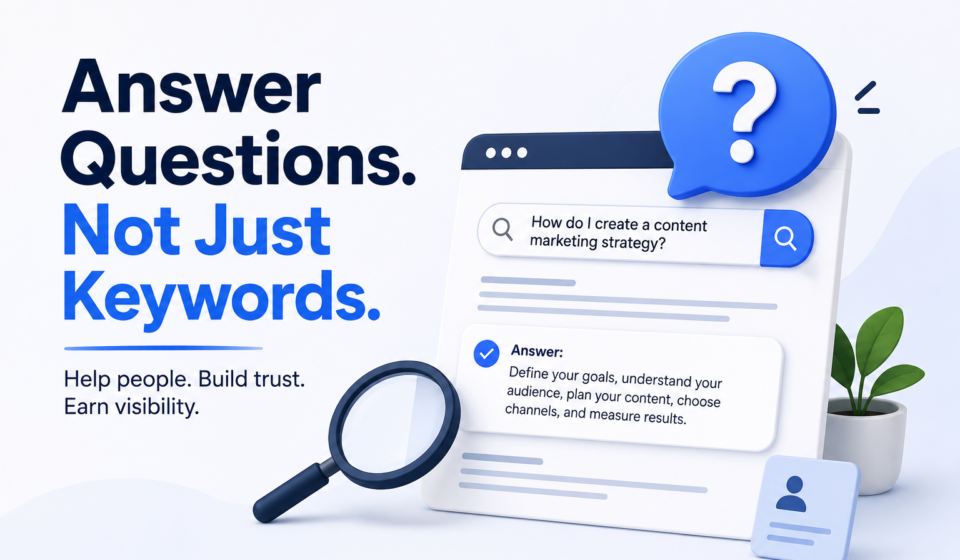
“How do I create a content marketing strategy?”
That difference matters.
Search is becoming more conversational, AI-powered, and intent-driven. People aren’t just typing keywords into a box anymore. They’re asking complete questions and expecting increasingly direct answers.
So if your content is still being built around keywords first and people second, you may be solving the wrong problem.
The better approach? Build content around the questions your audience actually needs answered.
Why Are Keywords Alone No Longer Enough?
Keywords still matter.
They help search engines understand what a page is about, and they remain useful for discovering search demand.
But a keyword doesn’t tell you the whole story.
Take “content marketing strategy.”
What does the person searching it actually want?
They might be asking:
- How do I create one?
- What should it include?
- Does it work for B2B?
- How much content do I need?
- How do I measure it?
One keyword can represent several different needs.
That’s why effective content starts moving beyond keyword matching toward intent matching.
The shift looks like this:
Keyword → Intent → Question → Answer → Content
The keyword helps you find the opportunity.
The question helps you understand the person.
What Is Question-Based Content?
Question-based content is not simply adding an FAQ section to every article.
It’s content built around the real questions, problems, objections, and decisions your audience has.
For example:
Keyword: content marketing strategy
Instead of immediately creating a generic article around the phrase, you could explore the questions behind it:
What is a content marketing strategy?
How do you create one?
What should a B2B content strategy include?
How long does content marketing take to work?
How do you know whether it’s working?
Now you’re not just targeting a keyword.
You’re building around a searcher’s journey.
And that creates content that’s useful beyond the first click.
What Makes a Good Search Answer?
The best answer isn’t necessarily the longest one.
It’s the one that removes the most uncertainty.
A strong answer should be:
Direct
Give the reader the answer before making them dig through three paragraphs of setup.
Useful
Don’t stop at definitions. Tell people what the information means or what they should do next.
Specific
“Create valuable content” isn’t useful advice.
“Interview three sales reps and identify the five questions prospects repeatedly ask before buying” is.
Contextual
The same question can have different answers depending on the industry, audience, product, or stage of the journey.
Credible
Experience, expertise, original research, examples, and evidence give an answer more weight than generic statements copied across the web.
Clear answers build clarity. Clear clarity builds trust.
Should Every Content Piece Start With a Question?
Not necessarily.
A strong content strategy still needs category pages, service pages, comparison pages, case studies, research reports, and other formats.
The point isn’t to turn everything into a question-and-answer article.
It’s to understand the question underneath the search.
A simple framework can help:
| Search intent | Question | Best content |
| Informational | What is content marketing? | Explainer |
| Problem-solving | How do I build a content strategy? | Guide |
| Comparison | SEO vs. content marketing? | Comparison |
| Commercial | Do I need a content agency? | Service page |
| Decision | How much does content marketing cost? | Buying guide |
The keyword gets you into the conversation.
Intent tells you what the conversation should be about.
How Should You Structure Content for Quick Answers?
People scan before they commit.
That’s true whether they’re reading on a laptop, asking a voice assistant, or looking for an answer inside an AI-powered search experience.
Your content should therefore be easy to:
Find → Understand → Scan → Extract → Act on
That means using:
- Question-led headings
- Direct answers near the top
- Short paragraphs
- Bullets and numbered lists
- Tables where comparisons help
- Clear definitions
- Step-by-step explanations
- Relevant examples
But don’t turn your writing into robotic answer blocks just because you’re thinking about AEO.
Write clearly because people want clarity—not because a search engine does.
Does Question-Based Content Help With AI Search?
It can make your content easier to understand.
And that’s important.
AI-powered search systems need to determine what information a page contains, which questions it addresses, how different concepts relate to one another, and whether the source appears trustworthy.
That makes clear structure valuable.
But there is no magic formula where adding ten questions to a page suddenly guarantees an AI citation.
The stronger approach is to create content that combines:
Clear answers + relevant context + genuine expertise + useful evidence
That’s where question-led content connects with AEO, GEO, and E-E-A-T.
Don’t write for an imaginary “AI reader.”
Write something an AI system can understand because a human reader genuinely finds it useful.
Where Do You Find the Questions Your Audience Is Actually Asking?
You don’t need to guess.
Some of the best questions are already sitting inside your business.
Look at:
- Google autocomplete
- People Also Ask
- Search Console
- Reddit discussions
- Customer support tickets
- Sales calls
- Customer reviews
- Community forums
- Related searches
- Competitor content
- Questions your internal experts answer repeatedly
Sales teams can be particularly valuable.
If prospects repeatedly ask:
“How long does this take?”
or
“What happens after I sign up?”
that’s not just a sales question.
It’s a content opportunity.
The best content research often starts closer to the customer than the keyword tool.
What Does Question-Led Content Look Like in Practice?
Imagine you’re creating content for a B2B content agency.
Instead of publishing one broad article called:
“The Complete Guide to Content Marketing”
you could build a connected journey:
What Is Content Marketing?
↓
Does Content Marketing Actually Work?
↓
How Much Does Content Marketing Cost?
↓
What Should a B2B Content Strategy Include?
↓
Should You Hire a Content Marketing Agency?
Each question serves a different intent.
The first helps someone understand the category.
The next addresses skepticism.
Then comes investment.
Then strategy.
Then the buying decision.
That’s not just keyword targeting. It’s content mapped to how people actually make decisions.
The Shift Isn’t From Keywords to Questions
Keywords aren’t going away.
The smarter shift is from keywords alone to understanding what those keywords represent.
Don’t just ask:
“What keyword should we rank for?”
Ask:
“What does someone need to know, understand, or decide when they make this search?”
Then create the clearest, most useful answer you can.
Because ranking gets you discovered.
A useful answer gives people a reason to stay.
Questions People Ask
1. Are keywords still important for SEO?
Yes. Keywords help identify search demand and topic relevance. They simply shouldn’t be the only factor guiding content.
2. What is question-based content?
Content designed around the questions, problems, and decisions your audience is actually trying to solve—not just keywords they might type.
3. How do I find questions people are searching for?
Use search suggestions, People Also Ask, Search Console, forums, customer questions, sales conversations, reviews, and competitor research.
4. How do I optimize content for voice search?
Use natural language, clear questions, concise answers, descriptive headings, and content that directly addresses conversational queries.
5. What is the difference between AEO and SEO?
SEO focuses broadly on improving visibility in search engines. AEO focuses more specifically on structuring useful information so answer systems can understand and surface it.
6. Does question-based content help AI search?
Clear, well-structured, authoritative content can make information easier for AI-powered systems to understand. However, no particular format guarantees inclusion in an AI-generated answer.
7. Should every blog post have an FAQ section?
No. Add FAQs when they answer genuinely relevant questions your audience has. An FAQ section shouldn’t exist simply to add keywords or increase word count.