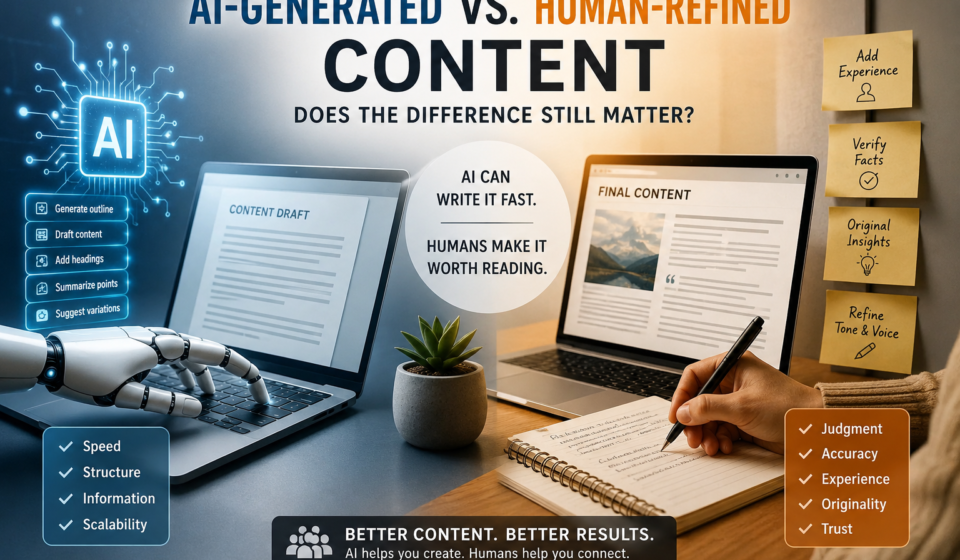
AI-Generated vs. Human-Refined Content: Does the Difference Still Matter?
The cheapest part of content creation might now be writing it.
That sounds like good news until you realize writing was never the only cost.
There’s the cost of choosing the wrong topic. Publishing an unsupported claim. Repeating what ten competitors already said. Building a page that attracts nobody. Spending months creating content that leaves no useful footprint.
AI can reduce the cost of production.
It can’t automatically reduce the cost of bad decisions.
That is where human refinement earns its place.
AI Is Good at More Than We Give It Credit For
There’s no point pretending AI is bad at content.
It isn’t.
AI can help writers research unfamiliar subjects, organize information, build outlines, identify gaps, generate variations, summarize source material, repurpose existing content, and get through the first draft faster.
Used well, that matters.
A writer who spends less time formatting information can spend more time questioning it. A strategist who can explore ten possible angles quickly can spend longer choosing the one worth pursuing.
The productivity gain is real.
The problem starts when speed becomes the strategy.
But “Well Written” Isn’t the Same as “Worth Reading”
Ask an AI tool to write about a familiar business topic and you’ll often get something perfectly acceptable.
That is exactly what makes it dangerous.
The article may have the right headings, relevant keywords, clean transitions, and all the expected talking points. It may even sound authoritative.
But where is the original thinking?
Google’s current guidance emphasizes content that is unique, valuable, reliable, and non-commodity. For generative AI search, Google specifically recommends bringing a unique point of view and first-hand experience rather than simply restating information already available elsewhere.
AI can organize what is known.
Your advantage comes from adding what isn’t.
What Human Refinement Actually Changes
Human refinement isn’t running a grammar check and replacing a few robotic phrases.
It’s the layer of judgment between “technically publishable” and “worth publishing.”
A good editor asks:
- Is this actually true?
- Where did this claim come from?
- Does the reader need this paragraph?
- What’s missing from the argument?
- Can we add something from first-hand experience?
- Is this genuinely useful or just familiar advice?
- Does this sound like the company or like everyone else?
- What should we remove?
Those decisions can completely change an article.
The final piece might still contain AI-assisted writing.
But the thinking behind it belongs to people.
AI-Assisted and AI-Generated Aren’t the Same Thing
These terms are often treated as interchangeable. They shouldn’t be.
AI-generated content typically puts the tool at the center of production.
AI-assisted content puts the workflow at the center.
That distinction matters.
A strong workflow might look like:
Research → Strategy → AI Assistance → Human Writing → Expert Review → Optimization
AI can help at several points.
It doesn’t need to own any of them.
Google’s guidance also makes this distinction important: generative AI can be useful for research and adding structure to original content, while generating large numbers of pages without adding value can fall under its scaled content abuse policies.
Does Google Care If AI Was Used?
Not in the way many people assume.
Google says its systems focus on the quality of content rather than whether AI or a human produced it. Using AI isn’t automatically a ranking advantage or penalty. Content created primarily to manipulate search rankings, however, can violate Google’s spam policies.
That changes the question businesses should be asking.
Don’t ask:
“Will Google know we used AI?”
Ask:
“Did using AI help us create something genuinely better?”
If the answer is no, the tool isn’t solving the right problem.
What About E-E-A-T?
AI can generate information.
It can’t give your company first-hand experience it doesn’t have.
That’s where Experience, Expertise, Authoritativeness, and Trustworthiness become important.
Google’s current guidance encourages creators to think about Who created the content, How it was created, and Why it exists. It also emphasizes original research, analysis, expertise, sourcing, and first-hand experience as useful signals of quality.
That means a generic article explaining an industry topic has limited differentiation.
An article built around your team’s experience, customer questions, original research, proprietary data, expert commentary, or a genuinely useful perspective has much more to contribute.
AI Search Raises the Bar Further
There’s another reason human refinement matters now.
People aren’t only searching with keywords.
They’re asking longer questions, following up, comparing options, and using AI-powered search experiences to make sense of information.
Google’s current guidance for AI features says the same fundamentals still apply: create helpful, reliable, people-first content and focus on unique, valuable information. It specifically warns against treating AEO or GEO as a collection of shortcuts or “hacks.”
In other words, there isn’t a magic AI-search format that makes mediocre content valuable.
The content still has to deserve the citation.
So What Does a Better Workflow Look Like?
The strongest approach isn’t AI vs. humans.
It’s knowing where each should contribute.
| Stage | AI can help with | Humans own |
| Research | Finding patterns and questions | Sources and interpretation |
| Strategy | Exploring angles | Final direction |
| Drafting | Speed and structure | Voice and argument |
| Editing | Suggestions | Judgment and accuracy |
| Optimization | Variations and organization | Search intent and usefulness |
| Publishing | Repurposing | Final approval |
The goal isn’t to hide AI.
It’s to put it in the right place.
The Difference Still Matters
Not because human-written content is automatically better.
And not because AI-generated content is automatically bad.
The difference matters because production has become cheap, while good judgment hasn’t.
AI can help you create more content.
Human expertise determines whether you should create it, what it should say, what evidence it needs, and whether it adds anything worth finding.
Google’s own guidance ultimately points in the same direction: content should be created to help people, offer original value, and demonstrate appropriate expertise—not simply to produce more pages for search.
AI changed how content gets made.
It didn’t change what makes content worth reading.
Questions People Ask
Can AI-generated content rank on Google?
Yes. Google says AI-assisted or AI-generated content can rank when it is helpful, original, reliable, and created for people. AI itself doesn’t provide a ranking advantage.
Does Google penalize AI-generated content?
No. Google doesn’t penalize content simply because AI was used. Content created primarily to manipulate search rankings can violate its spam policies.
Is AI-generated content better than human-written content?
Not automatically. AI is useful for speed and production, while humans bring expertise, experience, judgment, originality, and brand perspective.
Can AI-generated content hurt SEO?
AI isn’t inherently harmful to SEO. Low-quality, repetitive, unoriginal, or search-first content can perform poorly regardless of who or what produced it.
Should I use AI to write website content?
AI can support research, structure, and drafting. Important website content should still be reviewed by someone who understands the business, audience, subject, and desired outcome.
What is human-refined content?
Human-refined content uses AI where it improves efficiency while people remain responsible for research, expertise, accuracy, voice, editing, and final decisions.
Does AI content affect E-E-A-T?
AI use alone doesn’t determine E-E-A-T. What matters is whether the content demonstrates relevant experience, expertise, authority, and trustworthiness through factors such as original insight, accurate sourcing, and clear authorship.