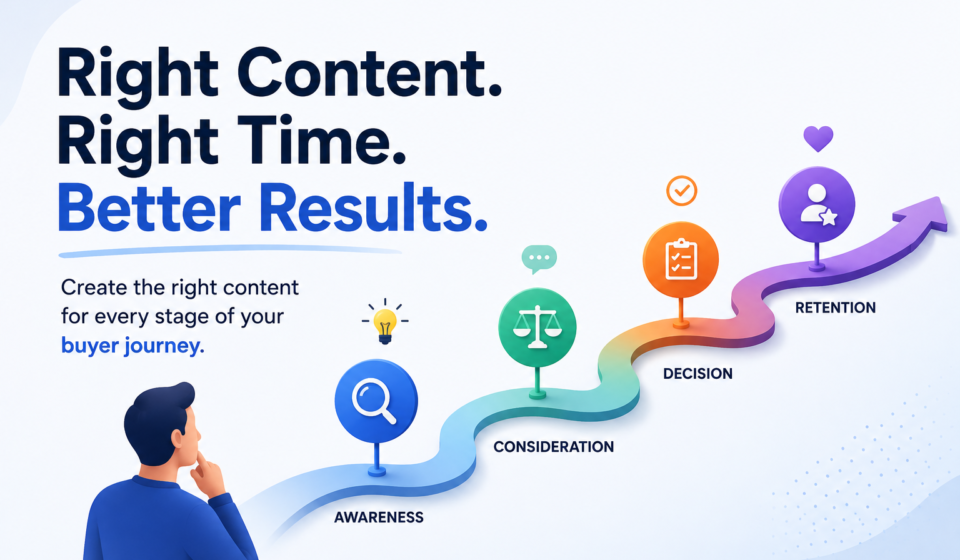
What Content Should You Create at Each Stage of the Buyer Journey?
Someone searching “what is content marketing?” isn’t looking for your pricing page.
And someone comparing content agencies probably doesn’t need another 1,500-word definition of content marketing.
They’re both potential customers. They’re just in very different places.
Yet many content strategies treat every reader the same- building around keywords, publishing schedules, and broad personas without considering what the reader actually needs at that moment.
A person discovering a problem needs context. Someone evaluating solutions needs evidence. Someone ready to buy needs confidence.
Your audience doesn’t need more content. They need the right content at the right time.
What Should You Publish at the Awareness Stage?
Awareness-stage readers aren’t necessarily looking for a company.
They’re looking for clarity.
They may have noticed a problem but don’t fully understand what’s causing it. Or they may be exploring an opportunity without knowing what solutions are available.
This is where your content should educate without immediately trying to sell.
Best content formats
- Beginner-friendly guides
- Educational blog posts
- Definitions and explainers
- How-to content
- Original research
- Industry trend reports
- Problem-focused articles
Consider someone searching:
“Why is my website traffic dropping?”
They’re probably not ready to hire an SEO agency.
They first need to understand what could be causing the decline and what they can investigate.
A service page isn’t the best answer.
A useful guide is.
The goal at this stage isn’t conversion. It’s clarity.
What Content Works Best at the Consideration Stage?
Once someone understands the problem, their questions change.
They’re no longer asking:
“What’s happening?”
They’re asking:
“What can I do about it?”
This is where your content needs to help them evaluate different approaches.
They may be comparing solutions, assessing alternatives, or trying to understand which approach makes sense for their situation.
Best content formats
- Comparison guides
- Alternatives articles
- Frameworks
- Expert guides
- Use cases
- Checklists
- Solution-focused content
For example:
Awareness:
Why Is My Website Traffic Dropping?
Consideration:
SEO vs. Paid Search: Which Is Better for Long-Term Growth?
The second reader doesn’t need a basic definition of SEO.
They’re evaluating options.
Your content should reflect that.
What Content Should You Create When Someone Is Ready to Buy?
Decision-stage readers don’t need another generic educational article.
They need confidence.
They’re asking:
- Can you actually solve this?
- Have you worked with businesses like mine?
- What does your process look like?
- What results have you achieved?
- What will working with you involve?
- Why should I choose you?
This is where content should become more specific and evidence-driven.
Best content formats
- Case studies
- Testimonials
- Service pages
- Product comparisons
- Pricing and ROI content
- Demonstrations
- Implementation guides
- Client examples
At this stage, proof becomes more valuable than promises.
Don’t simply say your content strategy works.
Show what happened when a real client used it.
What Content Should You Create After Someone Becomes a Customer?
The buyer journey doesn’t end at conversion.
Once someone becomes a customer, their questions change again.
Now they’re asking:
“How do I get the most value from this?”
That creates another opportunity for content.
Best content formats
- Tutorials
- Knowledge bases
- Advanced guides
- Customer newsletters
- Product education
- Troubleshooting resources
- Webinars
- Customer-only resources
Good retention content can help customers implement what they’ve purchased, solve problems faster, and get more value from the relationship.
Content shouldn’t stop working when the sale happens.
Can the Same Topic Work at Different Stages of the Buyer Journey?
Absolutely.
Take content marketing.
The topic can stay the same while the reader’s intent changes completely.
| Buyer stage | Example content |
| Awareness | What Is Content Marketing? |
| Consideration | Content Marketing vs. Paid Advertising |
| Decision | How Our Content Marketing Process Works |
| Retention | How to Measure Your Content Marketing Program |
The subject hasn’t changed.
The question has.
That’s why building a content strategy around keywords alone can leave gaps.
Two pages can target closely related topics while serving completely different purposes in the buyer journey.
How Can You Tell What Stage Your Reader Is In?
You don’t always need to ask.
Their behavior can provide useful signals.
Search intent
A broad informational query often signals an earlier stage.
Queries containing terms such as best, comparison, pricing, agency, software, or alternative can indicate stronger commercial intent.
Query complexity
Someone asking a basic definition question is likely in a different situation from someone comparing implementation approaches.
Content behavior
The pages someone visits, what they read next, and whether they return can reveal more about their journey.
Conversion behavior
Someone downloading a beginner’s guide is behaving differently from someone requesting a proposal.
None of these signals should be treated as absolute.
But together, they can give you a much clearer picture of what the reader needs next.
How Do You Match Content to Search Intent?
Start with the question behind the query, not just the keyword.
Consider these two searches:
“What is SEO?”
“Best SEO agency for SaaS companies”
Both are about SEO.
They’re not looking for the same thing.
The first reader wants to understand.
The second is evaluating providers.
That means the content should change accordingly- not just the keywords, but the format, depth, examples, proof, and CTA.
This is where search intent and buyer journey overlap.
Search tells you what someone is asking.
The journey helps you understand why they’re asking it now.
How Do You Build a Content Journey Instead of a Content Calendar?
Don’t start with:
“What should we publish this month?”
Start with:
“What will this reader need to know next?”
Imagine someone arrives through an article titled:
What Is Content Marketing?
Their next questions might be:
→ Does content marketing actually work?
→ How does it compare with paid advertising?
→ How much does content marketing cost?
→ How do I build a content strategy?
→ Should we do it in-house or hire an agency?
Those questions create a natural progression.
One useful piece leads to another.
The result isn’t a collection of disconnected blog posts.
It’s an information system that helps people move forward.
What Is the Biggest Mistake Businesses Make With Journey-Based Content?
Treating every reader as though they’re ready for the same message.
A beginner doesn’t need a sales pitch.
A comparison-stage buyer doesn’t need another definition.
A decision-stage buyer doesn’t need 2,000 words explaining the problem they’ve already researched.
The content itself might be good.
It can still fail if it arrives at the wrong moment.
That’s why personalization in content isn’t only about demographics.
Sometimes the most useful personalization is simply understanding what someone already knows and what they need to know next.
What Content Should You Create at Each Stage of the Buyer Journey?
The answer depends on what the reader is trying to accomplish.
| Buyer stage | What the reader needs | Best content |
| Awareness | Understanding | Guides, explainers, research |
| Consideration | Evaluation | Comparisons, frameworks, use cases |
| Decision | Confidence | Case studies, testimonials, demos |
| Retention | Success | Tutorials, resources, advanced guides |
The mistake is thinking every piece of content needs to sell.
It doesn’t.
Some content should educate.
Some should help people evaluate.
Some should prove that you can deliver.
And some should help customers succeed after they’ve chosen you.
Your content strategy becomes stronger when every piece has a job.
The Content Calendar Isn’t the Strategy
A calendar tells you when to publish.
The buyer journey tells you why the content needs to exist.
The strongest content strategies aren’t built by trying to produce something for everyone, every week.
They’re built by understanding what people need to know before they trust you, what they need to evaluate before they consider you, and what proof they need before they choose you.
Stop creating content for an audience. Start creating it for a moment.
Questions People Ask
1. What are the 4 stages of the buyer journey?
The four commonly used stages are awareness, consideration, decision, and retention. Some models use three stages and treat retention or advocacy separately.
2. What type of content is best for the awareness stage?
Educational guides, explainers, how-to articles, original research, and problem-focused content work well because readers are primarily looking for understanding.
3. What content should you create for consideration-stage buyers?
Comparison guides, alternatives, expert advice, frameworks, use cases, and checklists can help readers evaluate different solutions.
4. What content helps customers make a buying decision?
Case studies, testimonials, service pages, product comparisons, demonstrations, pricing information, and ROI-focused content can reduce uncertainty and build confidence.
5. How do I know what stage my audience is in?
Look at search intent, query language, content behavior, pages visited, returning visits, and conversion actions. These signals can help indicate whether someone is learning, evaluating, or preparing to act.
6. What is journey-based content?
Journey-based content is content designed around where someone is in their decision-making process. It gives readers information appropriate to their current questions, knowledge, and intent.
7. How does search intent affect the buyer journey?
Search intent helps reveal what someone is trying to accomplish with a query. Understanding that intent alongside the buyer journey allows you to create content that answers the right question at the right stage.